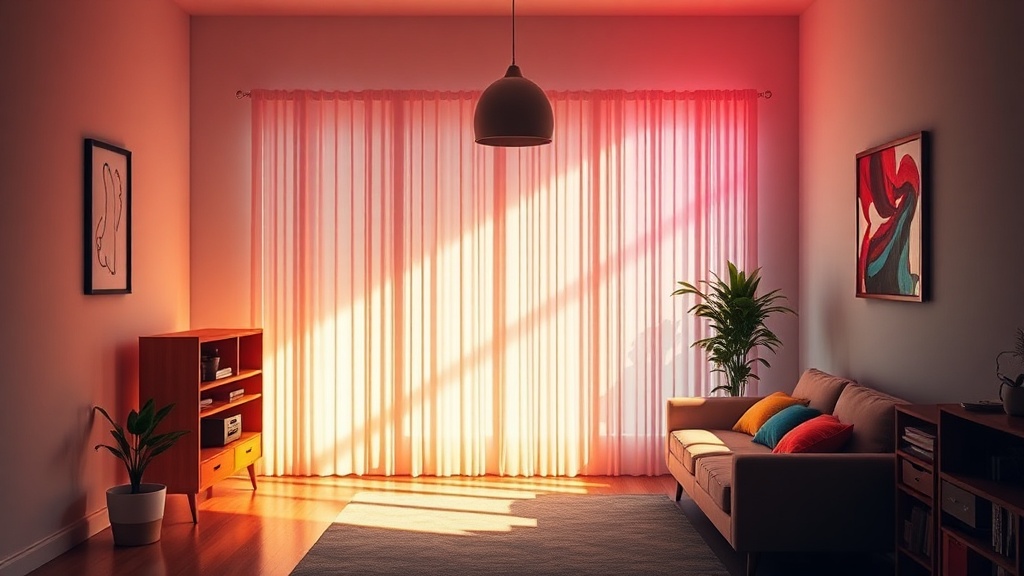
6 Ways to Use Color and Light to Change Your Mood

Warm Light for Evening Wind-Downs
Natural Sunlight for Morning Energy
Blue Tones for Focus and Calm
Yellow Accents for Optimism
Soft Pink for Emotional Comfort
Greenery and Earth Tones for Balance
Imagine sitting at your desk at 3:00 PM, staring at a bright, flickering overhead fluorescent light while the pale blue glow of your laptop screen strains your eyes. Your focus is drifting, your neck is tight, and a sense of low-level anxiety is beginning to settle in your chest. This isn't just a lack of caffeine; it is a physiological response to your immediate environment. The way light hits your retina and the specific wavelengths of color in your room directly influence your nervous system, your cortisol levels, and your circadian rhythm. This post outlines six practical ways to manipulate color and light to regulate your mood, boost your energy, or induce deep relaxation.
1. Use Warm Light to Signal the End of the Day
The human body is biologically programmed to respond to the shifting spectrum of light throughout the day. As the sun sets, the light shifts from high-energy blue wavelengths to low-energy amber and red wavelengths. When you rely on high-intensity "daylight" bulbs (which often exceed 5000K on the Kelvin scale) late into the evening, you suppress melatonin production, making it difficult for your brain to transition into sleep mode. To counteract this, switch to light sources with a color temperature between 2000K and 2700K.
Practical application involves moving away from "big lights"—the overhead fixtures—and toward "layered lighting." Instead of one bright source, use several smaller ones. A salt lamp, such as those from Himalayan Salt Co., or a dimmable Edison bulb lamp provides a warm, amber glow that mimics a campfire or sunset. This tells your parasympathetic nervous system that it is safe to begin the winding-down process. If you find it difficult to transition into sleep even with warm light, you might also consider using weighted blankets to supplement your sensory input for a more profound sense of physical security.
2. Incorporate Blue and Green for Cognitive Focus
While excessive blue light at night is detrimental, controlled exposure to blue-toned light during work hours can enhance alertness and cognitive function. Blue light suppresses melatonin and increases alertness by stimulating the melanopsin-containing cells in your eyes. However, the goal is not to stare at a screen, but to utilize the color to create a sense of "expansive" space. In color psychology, blue is associated with the sky and the ocean, which can reduce feelings of confinement in small home offices.
To use this effectively, incorporate blue and green elements into your workspace. This doesn't mean painting your walls neon blue; rather, use "biophilic design" principles. Place a large-leafed plant, like a Monstera Deliciosa or a Sansevieria (Snake Plant), in your line of sight. The green hues provide a "soft fascination" that allows your directed attention to rest without being fully distracted. If you need a sharp boost in focus, a desk lamp with a cool-white bulb (around 4000K) can help sharpen your mental clarity during a mid-morning slump.
3. Utilize Red and Terracotta for Grounding and Warmth
Red is a high-arousal color. While it can be overstimulating if used in large quantities, in smaller, controlled doses, it provides a sense of warmth, security, and "groundedness." In architectural design, red and earthy tones are used to make large, cold spaces feel more intimate. For mental health, these tones can help combat feelings of emptiness or "emptiness" that often accompany low-mood episodes.
Try incorporating terracotta pottery, copper accents, or deep ochre textiles into your living areas. These colors have a lower frequency and feel "heavy" in a way that is psychologically comforting. If you are feeling ungrounded or experiencing high anxiety, surrounding yourself with these warm, earthy textures can act as a visual anchor. This physical sensation of "weight" through color can be a helpful tool when you are also learning how to use a sensory journal to track your mood and identify which environments trigger your stability.
4. Manage Light Direction to Regulate Sensory Input
It isn't just the color of the light that matters, but the direction and the shadows it creates. Harsh, direct light from above creates high-contrast shadows, which can feel aggressive to a sensitive nervous system. This is often why people feel "on edge" in modern office buildings or brightly lit retail stores. To create a more regulated emotional state, you must master the art of indirect lighting.
Use "uplighting" to bounce light off the walls or ceiling. This softens the shadows and creates a more diffused, gentle light throughout the room. A floor lamp that shines upward, or placing a small light behind a large plant, creates a sense of depth and mystery rather than clinical brightness. This technique is particularly effective for reducing sensory overload during periods of high stress or when you are experiencing a "sensory crash" after a long day of social interaction.
5. Use Yellow for Gentle Stimulation
Yellow is often associated with sunlight and optimism, but in a domestic setting, too much bright yellow can lead to irritability or eye fatigue. To use yellow effectively for mood enhancement, think of it as a "highlight" color rather than a primary color. It should be used to draw the eye to specific, positive focal points in a room.
A single yellow ceramic vase, a mustard-colored throw pillow, or even a piece of art with golden tones can lift the mood of a room without being overwhelming. This is especially useful in spaces where you spend time in the morning. A touch of yellow in a breakfast nook or a reading corner can provide a gentle "wake-up call" to the brain, encouraging a sense of brightness and possibility as you start your day. This can be a great way to complement a 5-minute morning grounding routine, moving from the darkness of sleep into a state of gentle, bright readiness.
6. Control the "Light Scape" with Dimmers and Smart Bulbs
A static environment is a stagnant environment. To truly architect a life that supports your changing mental states, your lighting needs to be as dynamic as your mood. A single light switch that offers only "on" or "off" is a missed opportunity for emotional regulation. The most effective way to manage your internal state is to have total control over your external light scape.
Invest in smart bulbs (such as Philips Hue or LIFX) or, at the very least, plug-in dimmers for your lamps. This allows you to create "scenes" for different parts of your day. You can program a "Focus Scene" with bright, cool-white light for 10:00 AM, a "Relaxation Scene" with dim, warm amber light for 7:00 PM, and a "Deep Rest Scene" with almost zero light and a faint red glow for 10:00 PM. By treating light as a tool you can dial up or down, you move from being a passive recipient of your environment to an active designer of your mental well-being.
A Note on Implementation: Do not attempt to change every light in your home at once. Start with one room—ideally your bedroom or your primary workspace—and observe how the shift in color temperature affects your ability to transition between tasks and sleep.
By treating your living space as a structural support for your nervous system, you move beyond mere decoration. You are using the fundamental physics of light and the psychological weight of color to build a home that actively participates in your mental health journey.