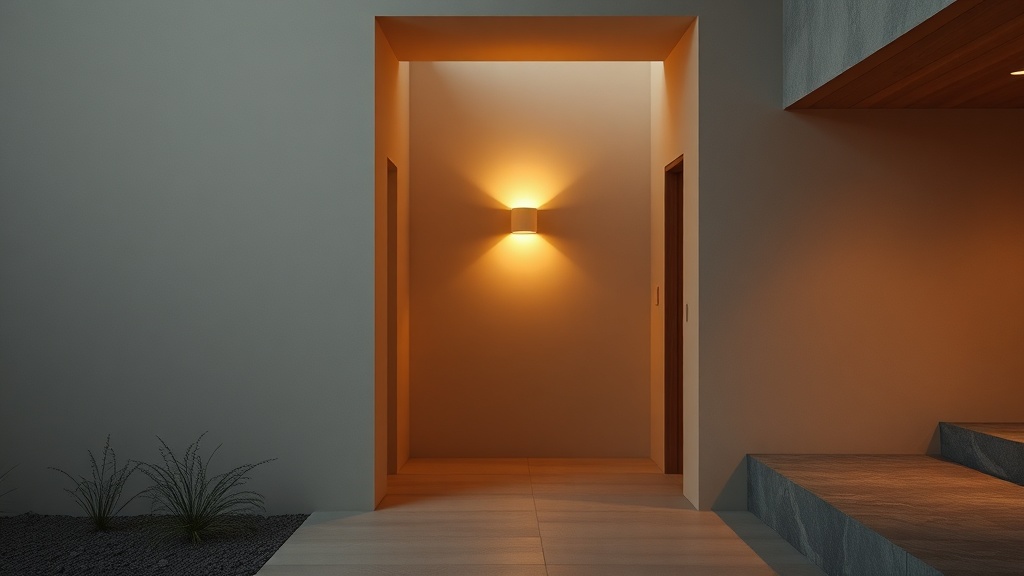
The Mental Mudroom: Designing Thresholds for Your Nervous System

There's a detail I used to obsess over in architecture meetings: the in-between space.
Not the grand kitchen. Not the magazine-worthy living room. The threshold. The mudroom. The foyer. The little zone where a person arrives, drops what they're carrying, and becomes someone who actually lives in the house.
In design terms, transition spaces do quiet, load-bearing work. Christopher Alexander wrote about this in A Pattern Language: buildings feel more humane when they sequence experience instead of dumping you from one state into another. You don't go street to sanctuary in one step. You pass through a gradient.
Most of us have erased that gradient from daily life.
Open-concept homes flattened room boundaries. Hybrid work dissolved commute boundaries. Laptops turned bedrooms into offices and kitchens into conference spillover. We cut out "wasted space," and then wondered why we feel permanently braced.
My opinion, plainly: a lot of modern burnout is threshold failure.
When there is no transition space, your body becomes the transition space.
The Cost of Zero-Transition Living
You end a tense Zoom call at 5:29 PM.
At 5:31 PM, you're chopping onions while your jaw is still locked.
At 5:36 PM, your partner asks a simple question and you snap.
At 9:00 PM, you're exhausted but wired.
This is not a character flaw. This is context switching without a nervous-system handoff.
Cognitively, you can switch tabs in a second. Somatically, you can't.
Your autonomic nervous system needs cues that the threat-demand loop is over. Sympathetic activation (mobilize, perform, solve, defend) does not instantly convert to ventral safety (connect, digest, rest) because your calendar says "off work." Down-regulation is physiological, not philosophical.
If you've ever thought, "Why can't I just relax?", that question is usually too moral and not architectural enough.
Try this one instead: Where is my threshold?
Your Nervous System Needs a Mudroom
A mudroom in a house has one job: contain outside weather before it coats the whole interior.
A mental mudroom does the same thing for psychological weather.
It gives stress hormones time to metabolize.
It gives attention a place to land.
It gives your body a repeatable signal: we are changing states now.
Without that signal, "home" becomes a second shift. You carry Slack cadence into dinner, bring decision fatigue into intimacy, and drag tomorrow's dread into sleep.
With a threshold, your evenings stop feeling like a crash landing.
How to Build a Mental Threshold in a Small Space
You do not need a bigger apartment. You need better sequencing.
Here is the framework I use with clients (and myself): Somatic cue + Sensory shift + Micro-ritual.
1) Somatic cue: tell the body the sprint is over
Pick one brief physical action you only do at shutdown:
- 90 seconds of longer exhales (for example, inhale 4, exhale 6)
- Legs up on a chair for two minutes
- Shoulder shake + jaw release + unclench hands
- A slow walk to the mailbox and back
The point is not optimization. The point is consistency. Repeated body cues become state-change anchors.
2) Sensory shift: change the environment on purpose
Your nervous system tracks light, sound, scent, and texture faster than it tracks affirmations.
Pick 1-2 reliable sensory switches:
- Turn off overhead task lighting, switch to one warm lamp
- Change your soundscape (focus playlist off, low-tempo music on)
- Wash your hands in warm water as a symbolic reset
- Put on a specific "off-duty" layer (sweater, socks, soft shirt)
You are creating contrast. No contrast, no threshold.
3) Micro-ritual: close one role before opening another
Keep it under five minutes.
- Write three lines: "What I finished / what can wait / what I need tonight"
- Physically close the laptop and place it out of sight
- Speak a single phrase out loud: "Work is done for today."
Rituals sound simple because they are. Their power is repetition, not complexity.
A Studio-Apartment Version (7 Minutes Total)
If your desk is three feet from your bed, use this exact sequence:
- Stand up when work ends. Two rounds of inhale 4, exhale 8.
- Put laptop and charger in a basket or drawer.
- Change one sensory input: lamp on, overhead off.
- Wash face or hands with warm water for 30-60 seconds.
- Write tomorrow's first task on paper.
- Step outside your door for one minute, then re-enter slowly.
That last step matters. You are manufacturing an arrival.
What This Is Really About
As a former architectural designer, I used to think good design was mostly about aesthetics and efficiency. Now I think good design is about nervous-system dignity.
A life can look beautiful and still feel uninhabitable.
Thresholds are how we make it inhabitable again.
If your afternoons collapse into that familiar hybrid-work fog, don't start with productivity hacks. Start with transitions. Build one small mudroom between labor and life, then protect it like load-bearing structure.
Because it is.