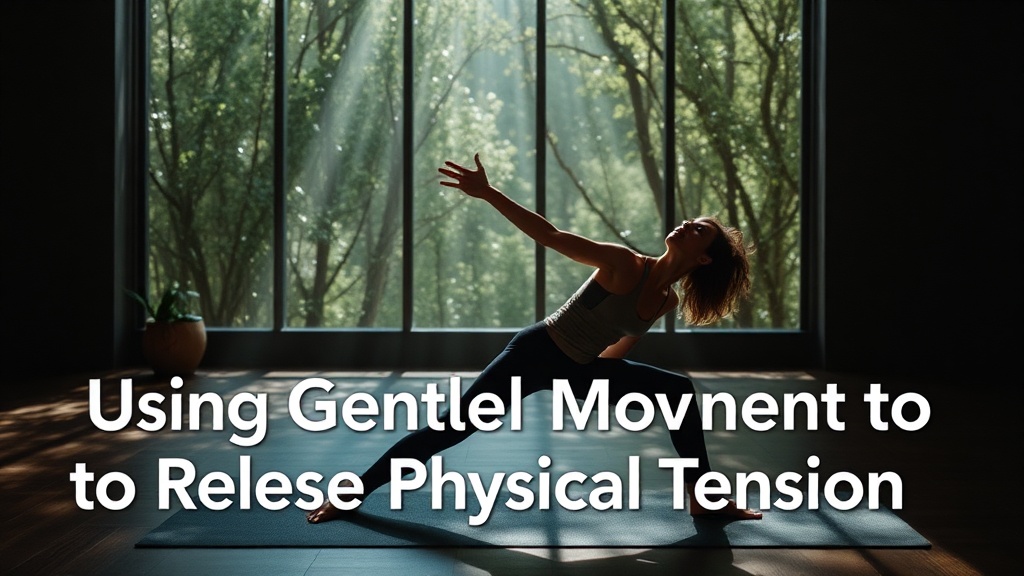
Using Gentle Movement to Release Physical Tension

Imagine you're sitting at your desk, and suddenly you realize your shoulders are practically touching your ears. Your jaw is clenched tight enough to crack a nut, and there's a dull, heavy ache sitting right at the base of your skull. This isn't just a bad posture problem; it's your nervous system holding onto stress. This post explores how to use gentle movement to signal to your brain that it's safe to let go of that physical tension.
We often treat movement as something we do to "burn calories" or "get fit." But from a somatic perspective, movement is a communication tool. When you're stuck in a high-stress state, your body often defaults to a rigid, defensive posture. You can't always think your way out of a tight chest or a clenched jaw—sometimes, you have to move your way out of it.
How Can I Release Physical Tension in My Body?
You can release physical tension by using low-intensity, rhythmic movements that prioritize sensation over intensity. Instead of pushing through a high-intensity workout when you're already stressed, try movements that focus on the edges of your range of motion. This might look like slow neck rolls, gentle spinal waves, or even just rhythmic swaying.
The goal here isn't to hit a personal record in the gym. It's about interoception—the ability to sense what is happening inside your body. When you move slowly, you actually start to notice where the tightness lives. You might find that your tension isn't just in your back, but actually lives in your hips or your diaphragm.
Think of your body like a building undergoing a structural inspection. If a beam is under too much pressure, you don't hit it with a sledgehammer; you adjust the load. Gentle movement is that subtle adjustment. It’s a way to redistribute the "weight" of your stress.
If you find that your mind is too loud to even notice your body, you might find more success starting with grounding techniques to calm anxiety first. Once your mind settles, the physical release becomes much easier to achieve.
The Difference Between High-Intensity and Low-Intensity Movement
It's a common mistake to think that a heavy lifting session or a sprint is the only way to "get the stress out." While exercise is great, high-intensity movement can sometimes actually spike your cortisol levels if your nervous system is already fried. If you're already in a state of burnout, a heavy CrossFit session might feel like another threat to your body.
Low-intensity movement, on the other hand, focuses on the parasympathetic nervous system—the "rest and digest" side of things. It's about telling your amygdala that there is no predator in the room. It's a soft, non-threatening way to interact with your biology.
| Type of Movement | Primary Goal | Best Used When... |
|---|---|---|
| High-Intensity (HIIT/Running) | Cardiovascular strength & calorie burn | You have high energy and need to release pent-up frustration. |
| Gentle Movement (Yoga/Stretching) | Nervous system regulation & mobility | You feel "wired but tired" or physically constricted. |
| Rhythmic Movement (Walking/Swaying) | Grounding & sensory integration | You feel dissociated or stuck in a mental loop. |
What Are the Best Gentle Movements for Stress Relief?
The best movements for stress relief are those that encourage fluid, circular motions rather than rigid, linear ones. When we are stressed, we tend to move in straight lines and sharp angles. To counter this, we want to reintroduce curves and waves into our physical repertoire.
Here are a few specific movements you can try right now:
- The Spinal Roll: Stand with feet hip-width apart. Slowly, one vertebra at a time, roll down toward the floor. Don't force it. Let your head hang heavy. As you roll back up, imagine you're stacking your spine like a precise architectural column.
- Shoulder Carousels: Instead of just rolling your shoulders up and down, try drawing small, slow circles with your elbows. It’s a much more subtle, circular motion that reaches the deeper muscles.
- Pelvic Tilts: While lying on your back, gently tilt your pelvis toward your face and then away. This addresses the tension that often settles in the lower back during long hours of sitting.
- Wrist and Ankle Circles: We often forget the extremities. Moving your wrists in slow, deliberate circles can help release the tension from typing or gripping a steering wheel.
If you're looking for a more structured way to move, look into Tai Chi. It's a practice built entirely on the concept of slow, intentional, and flowing movement. It’s essentially "moving meditation."
A Note on Props
Don't be afraid to use tools to help you move. If you can't reach the floor, use a sturdy chair. If your hips feel too tight for a deep stretch, grab a yoga block or even a thick book from your shelf. The point is to make the movement feel supportive, not like a struggle.
How Often Should I Move to Reduce Tension?
You should aim to incorporate gentle movement into your daily routine, ideally whenever you notice a spike in physical discomfort or mental stress. You don't need to set aside an hour; even three minutes of intentional movement can shift your state.
Consistency matters more than duration. If you wait until you're in a state of total physical collapse to move, you're playing catch-up. Instead, try to treat movement like a structural maintenance check. If you're sitting for an hour, stand up and move for two minutes. It keeps the "joints" of your life from getting stuck.
I often suggest a "movement snack" approach. This isn't about a big, daunting workout. It's about small, digestible moments of physical expression. This could be a quick stretch while your coffee is brewing or a few slow neck rolls while you're waiting for a file to download.
"The body keeps the score, and movement is one of the most direct ways to rewrite the narrative of tension."
Think about how you feel after a long walk in nature. You likely feel more expansive and less "tight." You can replicate that feeling indoors by focusing on the quality of your motion. A walk is essentially a series of rhythmic, bilateral movements that help the brain process information. You can bring that same rhythm to a seated position by swaying or even just gently bouncing your heels.
If you find your mind racing while you're trying to move, you might want to pair your movement with breathwork. Using box breathing during your stretches can help bridge the gap between your physical sensations and your mental state. It ensures you aren't just moving your limbs, but actually settling your nervous system.
It's also worth noting that your environment plays a role. If you're trying to do gentle movement in a cluttered, high-sensory-input room, your brain might still feel "on edge." Creating a small, dedicated space—even if it's just a corner of your rug—can signal to your brain that it's okay to transition into a slower mode.
The goal is to build a life that is structurally sound. Just as a building needs to be able to sway slightly during a storm to avoid breaking, your body needs the capacity to move and release tension to avoid breaking under the pressure of daily life. Start small, move with intention, and listen to what your body is actually telling you.
Steps
- 1
Scan your body for tension
- 2
Begin slow, rhythmic movements
- 3
Focus on deep, rhythmic breathing
- 4
Notice the sensation of release